
The Merchant Navy is made up of many different types of commercial vessels, each designed to perform a particular function at sea. Some ships transport manufactured products in containers, while others carry crude oil, chemicals, liquefied gases, vehicles, dry bulk cargo or even passengers. There are also specialised vessels that support offshore industries, heavy-lift operations and other maritime activities.
Understanding the different types of ships in the Merchant Navy is important for aspiring seafarers because the vessel they work on directly influences their daily duties, cargo operations, safety procedures, equipment and professional experience. A deck cadet joining a container ship, for example, will encounter a very different cargo operation from a cadet joining an oil tanker or LNG carrier.
There is no single universal classification system covering every vessel. The International Maritime Organization (IMO) uses different ship-type definitions across its conventions and regulations. Broadly, however, commercial ships can be understood according to what they transport and the purpose for which they are designed.
What are the different types of ships in the Merchant Navy?
The major types include container ships, bulk carriers, oil tankers, chemical tankers, gas carriers, general cargo ships, Ro-Ro vessels, vehicle carriers, refrigerated cargo ships, passenger ships, cruise ships, multipurpose vessels, heavy-lift ships and offshore support vessels.
Each category exists because different cargoes and maritime operations require different ship designs. Cargo characteristics, loading methods, storage requirements, stability, temperature, pressure, fire risk and environmental considerations all influence the construction and operation of a vessel.
For seafarers, this means that ship type is not merely a classification used in shipping documents. It determines the working environment onboard and the specialised knowledge that the crew must develop.
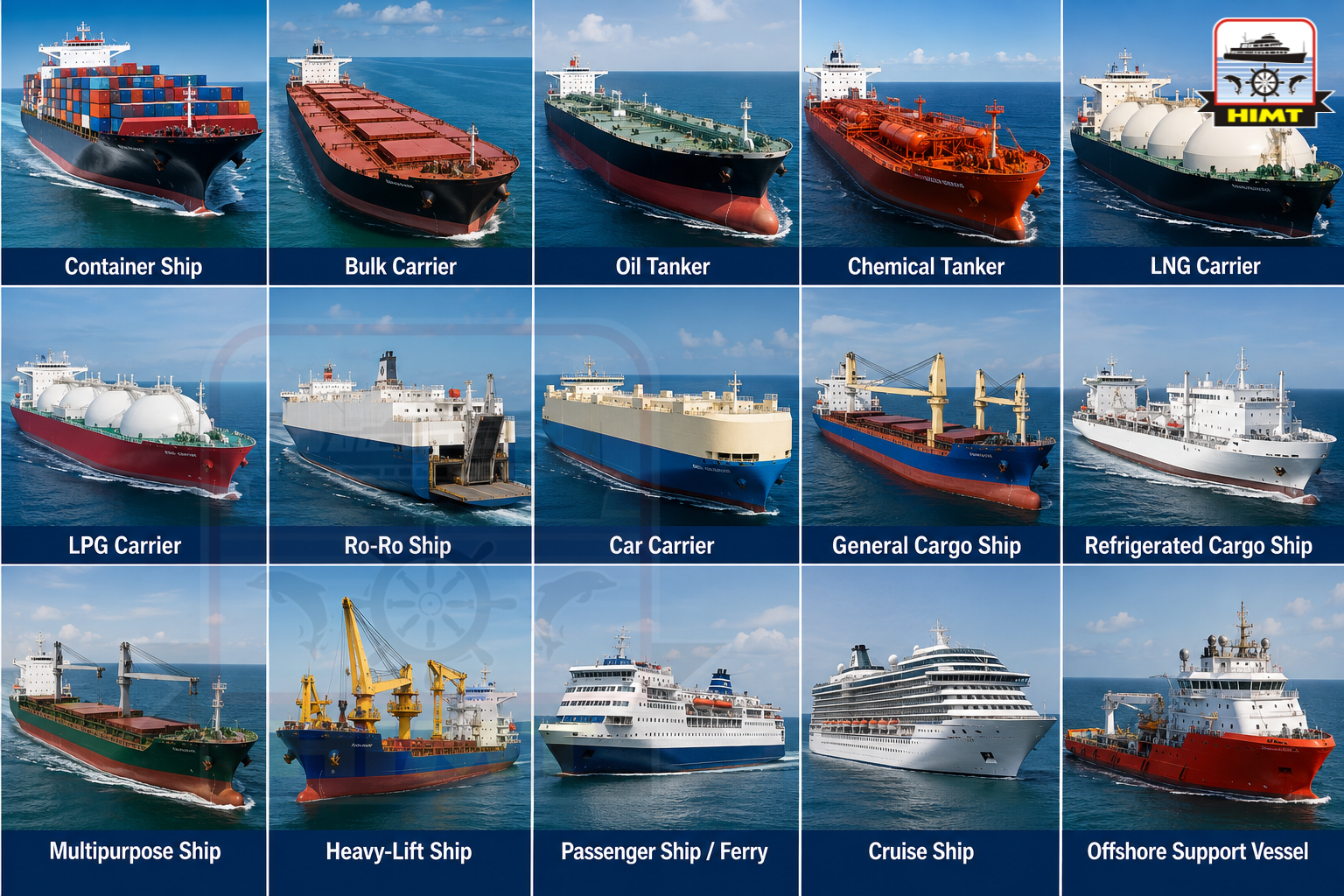
1. Container Ships
Container ships are designed to transport cargo packed inside standardised intermodal containers. These vessels form a major part of modern liner shipping and carry manufactured and consumer goods such as electronics, clothing, machinery, furniture, food products and automobile components.
Containers allow cargo to move efficiently between ships, trucks and railways without repeatedly handling the individual goods inside them. Large container ships can carry thousands of containers, while smaller feeder vessels connect smaller ports with major container hubs.
For deck officers and ratings, container operations involve cargo planning, lashing and securing, stability management, inspections and safe navigation. Marine engineers are responsible for the propulsion plant, electrical systems and numerous auxiliary systems required to operate the vessel.
2. Bulk Carriers
Bulk carriers transport large quantities of unpackaged dry cargo directly inside their cargo holds. Typical cargoes include iron ore, coal, grain, bauxite, cement and other commodities.
Unlike container ships, bulk carriers do not depend on individual cargo packages. Their cargo holds are designed to accommodate large quantities of material, and loading and unloading are generally performed using specialised shore equipment or onboard cargo gear.
Cargo distribution is particularly important because incorrect loading can affect the vessel’s stability and structural stresses. Seafarers therefore need to understand cargo loading plans, trimming, ballast operations and stability requirements. IMO specifically defines bulk carriers as ships primarily intended to carry dry cargo in bulk, including categories such as ore carriers and combination carriers.
3. Oil Tankers
Oil tankers are designed to transport petroleum products in bulk. They can carry crude oil or refined petroleum products such as diesel, gasoline and fuel oils.
Instead of conventional cargo holds, tankers have specialised cargo tanks connected to sophisticated piping, pumping, ventilation and monitoring systems. Cargo operations require strict procedures because petroleum products can create significant fire, explosion and pollution risks.
Working on oil tankers therefore requires strong knowledge of tanker safety, cargo handling, pollution prevention, emergency procedures and shipboard operations.
4. Chemical Tankers
Chemical tankers transport liquid chemical cargoes that may have different physical and chemical properties. Some cargoes can be toxic, corrosive, reactive or hazardous to the environment.
These vessels use specialised cargo tanks, pumps, pipelines and safety systems designed to prevent cargo contamination and protect the crew. Tank cleaning and cargo compatibility can also be important parts of operations.
For seafarers, chemical tankers provide a highly specialised working environment in which knowledge of cargo characteristics, protective equipment, emergency response and safe cargo handling is essential.
5. LNG and LPG Carriers
Gas carriers transport gases in liquefied form. LNG carriers transport Liquefied Natural Gas, while LPG carriers transport Liquefied Petroleum Gas.
Liquefaction significantly reduces the volume of gas and makes large-scale transportation possible. However, these vessels require specialised cargo containment systems, insulation, pressure control, refrigeration and monitoring arrangements.
LNG and LPG carriers therefore require highly trained crews who understand specialised cargo systems and the hazards associated with liquefied gases. For marine engineers in particular, these vessels can provide exposure to sophisticated propulsion, cargo and auxiliary systems.
6. General Cargo Ships
General cargo ships are designed to carry cargo that may not be suitable for containers or bulk carriers. Depending on the vessel, they can transport machinery, steel products, timber, bags, equipment and other unitised or break-bulk cargo.
Many general cargo vessels are equipped with their own cranes or cargo-handling equipment, allowing them to operate at ports where shore-based equipment may be limited.
IMO describes a general cargo ship as a single or multi-deck vessel designed primarily to carry general cargo.
These ships can provide seafarers with broad practical experience in traditional cargo handling, seamanship, ship maintenance and port operations.
7. Ro-Ro Ships and Vehicle Carriers
Ro-Ro stands for Roll-on/Roll-off. These vessels are designed so that wheeled cargo can be driven or moved directly onto and off the ship through ramps.
Ro-Ro cargo can include cars, trucks, trailers, buses and heavy wheeled machinery. Vehicle carriers, including Pure Car Carriers (PCCs) and Pure Car and Truck Carriers (PCTCs), are specialised Ro-Ro vessels designed primarily for transporting vehicles.
Cargo securing is particularly important because vehicles must remain safely secured throughout the voyage. Some vessels combine vehicle transportation with other cargo capabilities.
8. Refrigerated Cargo Ships
Refrigerated cargo ships, commonly known as reefer ships, are designed to transport temperature-sensitive cargo under controlled conditions.
Typical cargoes include fruits, vegetables, seafood, meat and other products that require controlled temperatures during transportation. The vessel therefore needs specialised refrigeration equipment and continuous monitoring.
Although a significant amount of refrigerated cargo is now transported in refrigerated containers, specialised reefer vessels continue to represent an important category of commercial shipping.
9. Multipurpose and Project Cargo Ships
Multipurpose vessels are designed to carry different kinds of cargo rather than being restricted to one specialised cargo category. They may carry containers, general cargo, bulk cargo, machinery or project cargo depending on their design and trade.
Project cargo ships are particularly useful for transporting large or unusual industrial equipment that cannot easily be transported using standard container ships.
Their flexibility can make cargo planning more complex because different cargoes may require different handling, securing and stability arrangements.
10. Heavy-Lift Ships
Heavy-lift vessels are specialised ships designed to transport extremely heavy or oversized cargo. Their cargo may include industrial machinery, transformers, generators, cranes, offshore equipment and other large structures.
Some heavy-lift ships have powerful onboard cranes capable of lifting cargo that conventional cargo vessels cannot handle.
Heavy lifting requires careful stability calculations and operational planning. The crew must consider factors such as crane loads, vessel stability, cargo securing and weather conditions during lifting and transportation.
11. Passenger Ships
Passenger ships are an important category that should not be overlooked when discussing commercial ships and careers at sea. IMO generally defines a passenger ship as a ship carrying more than 12 passengers under the relevant SOLAS definition.
Passenger ships are designed primarily to transport people rather than commercial cargo. They can include passenger ferries, passenger liners and other vessels designed for regular passenger transportation.
The operational environment is significantly different from that of a conventional cargo vessel because passenger safety becomes a major operational priority. Emergency preparedness, evacuation arrangements, fire safety, crowd management and lifesaving systems are particularly important.
For seafarers, passenger ships can provide opportunities in deck, engine and other maritime departments, although the onboard environment can involve substantially more interaction with passengers than cargo vessels.
12. Cruise Ships
Cruise ships are a specialised form of passenger vessel designed primarily around passenger accommodation, travel and onboard leisure experiences. Unlike a conventional transport vessel whose primary purpose is to move passengers from one destination to another, a cruise ship is also a destination in itself.
Modern cruise ships can contain accommodation, restaurants, theatres, swimming pools, entertainment areas and other facilities. Consequently, they require large and diverse crews compared with many cargo ships. IMO notes that cruise ships can carry very large numbers of passengers and crew and are subject to extensive safety and environmental requirements.
For maritime professionals, cruise ships can offer careers in navigation, marine engineering, safety and other shipboard departments. However, the operational focus and onboard working environment are considerably different from those of cargo ships.
13. Ro-Pax Ships and Ferries
Ro-Pax vessels combine two functions: they carry passengers and roll-on/roll-off vehicles. Ferries are commonly used to transport people, cars, buses, trucks and other vehicles between ports, particularly on shorter or regional routes.
Their design requires efficient passenger accommodation, vehicle decks, ramps and comprehensive lifesaving and emergency arrangements.
Because these vessels combine passenger and vehicle operations, crew members must understand both passenger safety and vehicle-cargo management. Passenger ships operating internationally are subject to specific IMO safety requirements, including provisions under SOLAS.
14. Offshore Support Vessels
Offshore support vessels serve industries and installations operating at sea rather than functioning primarily as conventional cargo carriers. They can support offshore energy, construction, exploration and other maritime activities.
Examples include Platform Supply Vessels, Anchor Handling Tug Supply vessels and specialised offshore construction support vessels. Depending on their purpose, they may transport equipment and supplies, handle anchors, support offshore construction or perform other specialised operations.
These vessels can involve advanced navigation and station-keeping technologies, including dynamic positioning on suitably equipped vessels. Offshore work can therefore require additional technical and operational expertise.
15. Specialised and Special-Purpose Ships
Some commercial vessels are designed for highly specific functions and do not fit neatly into the major cargo categories. These can include vessels supporting specialised industrial operations, scientific activities or other maritime missions.
IMO also recognises special purpose ships under its regulatory framework. A special purpose ship is defined in the relevant code as a mechanically self-propelled ship that carries more than 12 special personnel because of its function.
The exact requirements and crew structure depend heavily on the vessel’s purpose and the type of operation being performed.
How do different types of ships help the Merchant Navy?
The Merchant Navy depends on different ship types because international trade does not involve a single type of cargo or passenger movement. Manufactured products require container ships, raw materials require bulk carriers, energy products require tankers and gas carriers, and vehicles require specialised Ro-Ro vessels.
Passenger ships and cruise vessels add another important dimension by transporting people and supporting the global tourism and passenger transportation sectors. Offshore and special-purpose vessels support industries that operate beyond conventional port-to-port cargo transportation.
Together, these vessels form a diverse maritime ecosystem that keeps international commerce, energy supply chains, passenger transportation and offshore activities operating.
Which type of ship is best for a Merchant Navy career?
There is no universally best ship type for every seafarer. The appropriate choice depends on a person’s qualifications, career objectives, technical interests and preferred working environment.
Those interested in conventional cargo operations may find container ships, bulk carriers or general cargo vessels suitable. Seafarers interested in specialised cargo may consider oil, chemical or gas carriers. Those interested in passenger operations may explore ferries or cruise ships, while professionals interested in specialised marine operations may consider offshore vessels.
The quality of training, safety culture, onboard experience and opportunities for career progression are often more important than simply choosing a particular ship category.
Conclusion
The Merchant Navy is far more diverse than a simple distinction between cargo ships and tankers. It includes vessels designed to transport containers, dry bulk cargo, liquids, gases, vehicles, refrigerated products, passengers and specialised project cargo, as well as ships supporting offshore and other maritime industries.
For aspiring seafarers, understanding these ship types is valuable because the vessel determines much of the operational environment in which they will work. The cargo, equipment, safety requirements, crew structure and daily responsibilities can differ significantly from one vessel to another.
A strong understanding of ship types therefore helps future seafarers make better-informed career decisions. Whether the goal is to work on a container ship, bulk carrier, tanker, LNG carrier, cruise ship, Ro-Ro vessel or offshore support vessel, each category offers a distinct maritime experience and requires professionals who can operate safely, efficiently and responsibly at sea.
FAQs
1. What are the different types of ships in the Merchant Navy?
The major types include container ships, bulk carriers, oil tankers, chemical tankers, LNG/LPG carriers, Ro-Ro ships, car carriers, general cargo ships, passenger ships and specialised vessels. Each ship is designed for a specific cargo type or maritime operation.
2. Which type of ship is best for a Merchant Navy career?
There is no single best ship; the right choice depends on your career goals, qualifications and preferred type of cargo or operation. Container ships and bulk carriers offer conventional cargo experience, while tankers and gas carriers provide specialised career paths.
3. What cargo do different Merchant Navy ships carry?
Container ships carry containerised goods, bulk carriers transport commodities such as coal and iron ore, while tankers carry liquids such as crude oil, petroleum products and chemicals. LNG/LPG carriers transport liquefied gases, whereas Ro-Ro and car carriers are designed mainly for wheeled vehicles.
4. What is the difference between a bulk carrier and a container ship?
A bulk carrier transports unpackaged dry cargo directly inside its cargo holds, such as coal, grain and iron ore. A container ship carries cargo packed inside standardised containers that can be transferred between ships, trucks and trains.
5. How does the type of ship affect a seafarer’s job?
The ship type determines the cargo operations, equipment, safety procedures and specialised skills that seafarers encounter onboard. For example, tanker crews handle specialised liquid cargo systems, while container ship crews work extensively with container stowage and securing.