
If you are planning to join the Merchant Navy or are preparing for maritime entrance exams such as IMU CET, one of the first subjects you should learn is General Ship Knowledge (GSK). Understanding the basic parts of a ship, its departments, equipment, safety systems, and common maritime terms helps students build a strong foundation before starting practical training.
Whether you are interested in becoming a Deck Officer, Marine Engineer, Electro-Technical Officer (ETO), or GP Rating, learning general ship knowledge is essential. This guide explains the fundamentals, making it easy for beginners to understand.
What is General Ship Knowledge?
General Ship Knowledge (GSK) refers to the basic understanding of a ship’s structure, equipment, operations, safety procedures, and maritime terminology. It helps seafarers understand how a ship is built, how it operates, and how different departments work together to ensure safe and efficient voyages.
Every maritime student should know:
- Ship parts
- Ship types
- Ship departments
- Navigation basics
- Safety equipment
- Shipboard communication
- Pollution prevention
- Cargo handling basics
These concepts are commonly asked in maritime entrance examinations and interviews.
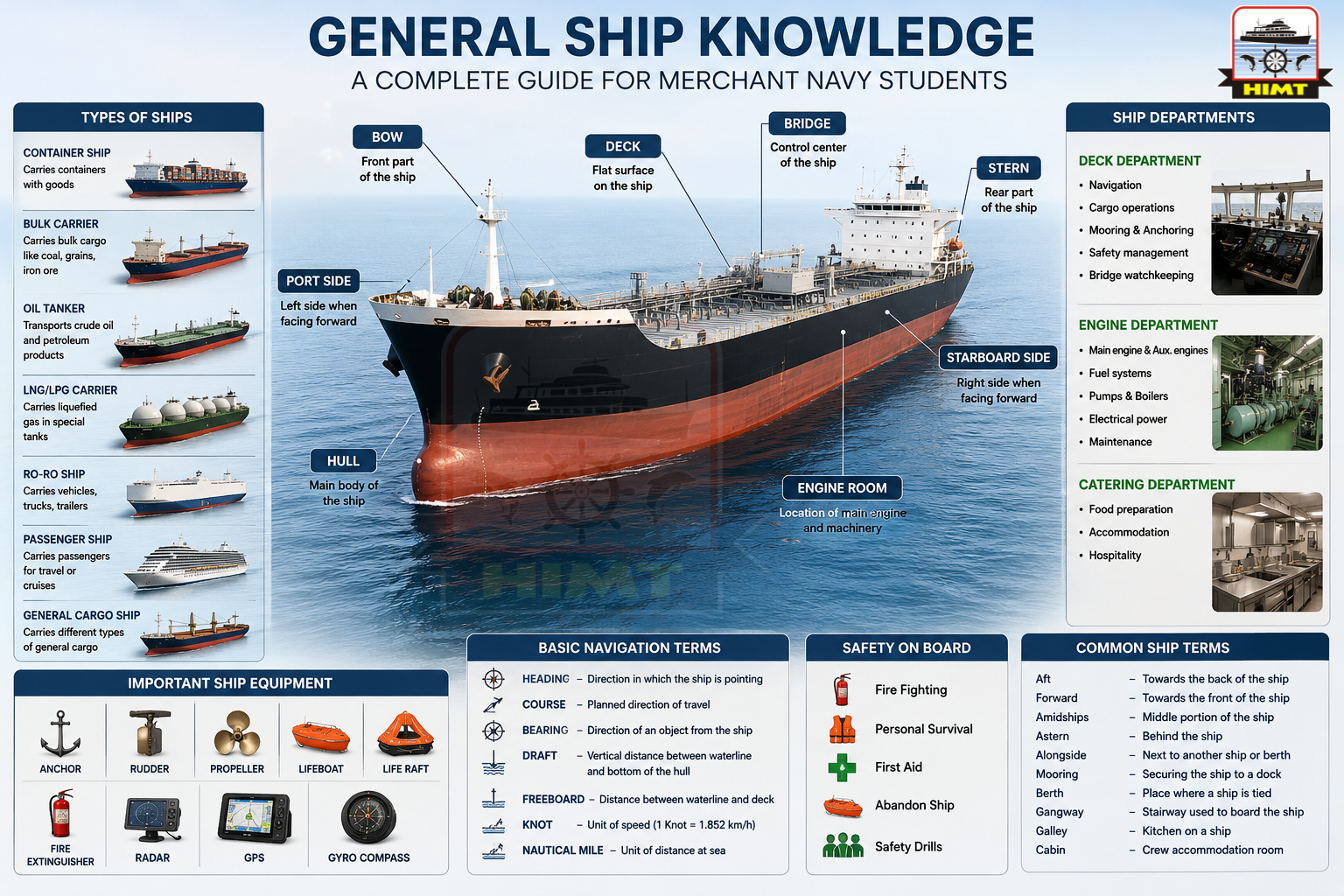
Main Parts of a Ship
Understanding the major parts of a ship is the first step in maritime education.
Bow
The Bow is the front part of the ship. It is designed to cut through the water efficiently, reducing resistance.
Stern
The Stern is the rear part of the ship. The propeller and rudder are usually located here.
Port Side
When facing the bow, the left side of the ship is called the Port Side.
Starboard Side
When facing the bow, the right side is called the Starboard Side.
Hull
The Hull is the main body of the ship that floats on water and provides structural strength.
Deck
The Deck is the flat surface where crew members walk and cargo operations take place.
Bridge
The Bridge is the ship’s control centre where navigation and steering are managed by the deck officers.
Engine Room
The Engine Room contains the main engine, generators, pumps, boilers, and other machinery required for propulsion and power generation.
Types of Ships
Merchant ships are designed for different purposes depending on the cargo they carry.
Container Ship
Used to transport containers carrying manufactured goods worldwide.
Bulk Carrier
Carries unpackaged bulk cargo such as coal, iron ore, grains, and cement.
Oil Tanker
Transports crude oil, petroleum products, and chemicals.
LNG and LPG Carrier
Specially designed ships used to transport Liquefied Natural Gas (LNG) and Liquefied Petroleum Gas (LPG).
Passenger Ship
Carries passengers between ports or on cruise vacations.
Ro-Ro Ship
Roll-on/Roll-off ships transport vehicles such as cars, trucks, and trailers.
General Cargo Ship
Carries different types of cargo that are not transported in containers.
Departments on a Ship
Every merchant ship has different departments responsible for specific operations.
Deck Department
The Deck Department is responsible for:
- Navigation
- Cargo operations
- Mooring
- Anchoring
- Safety management
- Bridge watchkeeping
Typical ranks include:
- Captain (Master)
- Chief Officer
- Second Officer
- Third Officer
- Deck Cadet
- Bosun
- Able Seaman (AB)
- Ordinary Seaman (OS)
Engine Department
The Engine Department manages:
- Main engine
- Auxiliary engines
- Fuel systems
- Pumps
- Boilers
- Electrical power generation
- Maintenance
Ranks include:
- Chief Engineer
- Second Engineer
- Third Engineer
- Fourth Engineer
- Junior Engineer
- Engine Cadet
- Motorman
- Oiler
Catering Department
This department takes care of food preparation and accommodation.
Common crew members include:
- Chief Cook
- Steward
- Messman
Important Ship Equipment
Every ship carries equipment required for safe navigation and operations.
Anchor
Keeps the ship fixed in one position while at sea or in port.
Rudder
Controls the direction of the ship.
Propeller
Provides forward or backward movement by converting engine power into thrust.
Lifeboat
Used to evacuate crew during emergencies.
Life Raft
Inflatable survival craft used if abandoning ship becomes necessary.
Fire Extinguishers
Installed throughout the ship to fight different classes of fire.
Radar
Detects nearby ships, land, and obstacles even during poor visibility.
GPS
Provides accurate ship positioning anywhere in the world.
Gyro Compass
Indicates true north and helps maintain the ship’s course.
Basic Navigation Terms
Every maritime student should know these common navigation terms.
- Heading – Direction in which the ship is pointing.
- Course – Planned direction of travel.
- Bearing – Direction of an object from the ship.
- Draft – Vertical distance between the waterline and the bottom of the hull.
- Freeboard – Distance between the waterline and the deck.
- Knot – Unit used to measure ship speed (1 Knot = 1.852 km/h).
- Nautical Mile – Standard unit of distance used at sea.
Safety on Board
Safety is the highest priority in the maritime industry.
Every crew member receives training in:
- Fire Fighting
- Personal Survival Techniques
- First Aid
- Personal Safety and Social Responsibility
- Emergency evacuation
- Abandon ship procedures
Crew members regularly participate in:
- Fire drills
- Lifeboat drills
- Oil spill response drills
- Security drills
These exercises prepare everyone to respond effectively during emergencies.
Pollution Prevention
Modern ships follow strict international rules to protect the marine environment.
Crew members help prevent pollution by:
- Proper garbage segregation
- Safe disposal of oily water
- Preventing oil spills
- Managing sewage responsibly
- Reducing air emissions
- Following environmental regulations
Protecting the oceans is an important responsibility of every seafarer.
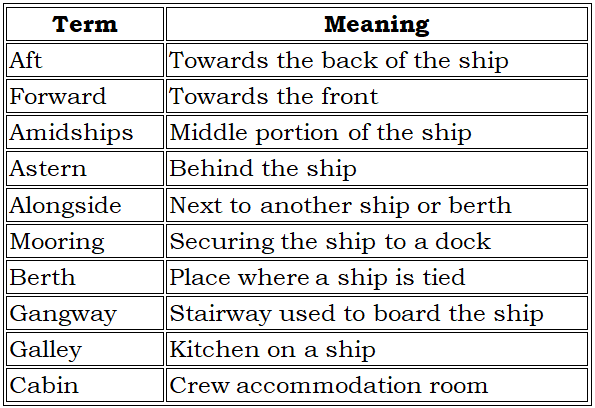
Common Ship Terminology
Learning maritime vocabulary helps students communicate effectively onboard.
Why General Ship Knowledge is Important
General ship knowledge is essential because it helps students:
- Understand ship operations
- Prepare for maritime entrance exams
- Perform confidently during interviews
- Communicate effectively onboard
- Improve safety awareness
- Build a strong foundation for maritime careers
Almost every shipping company expects cadets to have basic ship knowledge before joining.
Career Opportunities After Learning Ship Basics
Students who understand general ship knowledge can pursue careers such as:
- Deck Cadet
- Marine Engineer
- Electro-Technical Officer (ETO)
- GP Rating
- Navigation Officer
- Chief Engineer
- Captain (Master)
- Marine Surveyor
- Port Officer
- Maritime Safety Officer
With experience, seafarers can also move into shore-based roles in shipping companies, ports, maritime training institutes, and logistics organizations.
Tips for Maritime Students
If you are preparing for a Merchant Navy career:
- Learn the names and functions of ship parts.
- Understand the responsibilities of each department.
- Memorize common maritime terms.
- Study basic safety equipment and emergency procedures.
- Practice identifying different types of ships.
- Read about navigation and ship operations regularly.
- Stay updated with international maritime regulations.
Consistent learning will make your maritime training easier and improve your confidence during interviews and onboard training.
Conclusion
General Ship Knowledge is the foundation of every successful maritime career. From understanding the parts of a ship to learning navigation basics, safety procedures, ship departments, and maritime terminology, these concepts prepare students for life at sea.
Whether you aspire to become a Captain, Marine Engineer, ETO, or any other maritime professional, mastering these fundamentals is the first step toward a rewarding career in the Merchant Navy. By continuously improving your ship knowledge and practical understanding, you will be better prepared for maritime education, examinations, onboard training, and future opportunities in the global shipping industry.
FAQs
1. Is General Ship Knowledge important for IMU CET and Merchant Navy interviews?
Yes. Questions about ship parts, ship types, safety equipment, and maritime terminology are commonly asked in IMU CET, sponsorship interviews, and cadet selections.
2. I find it difficult to remember ship parts and maritime terms. What should I do?
Study labelled ship diagrams regularly and revise a few terms every day. Visual learning and repeated practice make it easier to remember.
3. Do Deck Cadets and Engine Cadets need to learn the same General Ship Knowledge?
Yes. While their specialized training differs later, both cadets must understand the basic structure of a ship, safety procedures, and common maritime terminology.
4. Can I join the Merchant Navy without knowing General Ship Knowledge?
Yes, you can join as a beginner, but having basic ship knowledge gives you an advantage in entrance exams, interviews, and onboard training.
5. What is the best way for beginners to learn General Ship Knowledge quickly?
Start with ship parts, ship types, departments, and safety equipment before moving to navigation basics. Watching ship diagrams and educational videos alongside reading will help you learn faster.